
Increasing walleye are causing regional concern over impacts to salmon, steelhead
Walleye experts from across the region convened for a State of the Science panel discussion with the Fish and Wildlife Committee at the October Council meeting in Donnelly, Idaho (watch video).
Walleye have been present in the Columbia River Basin since they were introduced to Lake Roosevelt in the 1950s, but have become of significantly greater concern in the last decade or so. While they are popular with anglers in some locations, increasing numbers of these predatory fish are creating challenges for salmon, steelhead, and lamprey, especially in the Lower Snake River.
In response to the urgency of this issue, three state fish and wildlife agencies recently issued the following statement:
“Idaho, Oregon, and Washington (three States) consider walleye in the Snake River reach between Lower Granite Dam and Hells Canyon Dam as an incompatible species with native salmonids. The presence of walleye within this reach compromises salmon and steelhead recovery. In response, the three States plan research and management actions aimed at reducing the walleye population. To help support these efforts, we encourage anglers to harvest the walleye they encounter.”
The Council’s Fish and Wildlife Program has had strategies to address non-native and invasive species and predator management since 2014; the recently adopted 2026 Program continues to build on those strategies and introduced specific measures to address walleye.
Regional fish and wildlife managers have already begun coordinating around the issue through an informal work group facilitated by Fisheries Biologist Marika Dobos with the Idaho Department of Fish and Game (IDFG).
Walleye Panel
The first presenters were Dr. Jonny Armstrong, Associate Professor at Oregon State University, and Andrew Murdoch with the Washington Department of Fish and Wildlife (WDFW) (see slides).
Murdoch and Armstrong focused on their research into food web impacts, and in particular if the presence of invasive species can alter the food web in a way that then benefits other invasive species. Their project focused on understanding which prey walleye are eating- invasive vs native species- and when.
The results showed two pulses of prey for walleye each year. The first pulse consists primarily of salmonids (and some lamprey) in the spring, and the second pulse is primarily of invasive American shad in the fall. Invasive Siberian prawns were a small but steady contributor throughout the year.
“Siberian prawns are the most commonly encountered prey in walleye diets,” said Armstrong. “So you can think of them kind of like potato chips. They’re just this year-round snack that walleye always have, but they don’t necessarily make up a huge proportion of their diet by mass.”
Overall, their analysis demonstrated that the increase in invasive species like shad and Siberian prawns in the basin is likely contributing to increased walleye numbers, and possibly to the expansion of their range. However, it does not seem to decrease the amount of salmonids that walleye consume because of the timing of the pulses.
“90% of the shad are spawning in the Columbia,” said Murdoch. “There’s a lot of walleye out there. So I’ll say go fishing. No limits. Unless we start getting serious, there’s going to be walleye in the Columbia mainstem for a long time.”
Next to present was Dobos, who facilitates the Snake River Basin Nonnative Piscivore Group. While the group is known for its work on walleye, Dobos emphasized that smallmouth bass and other invasive species are an increasing issue as well. She was joined by Grant Waltz, Fish and Wildlife Biologist with ODFW, and Jason Vogel, Fisheries Division Director for the Nez Perce Tribe (see slides).
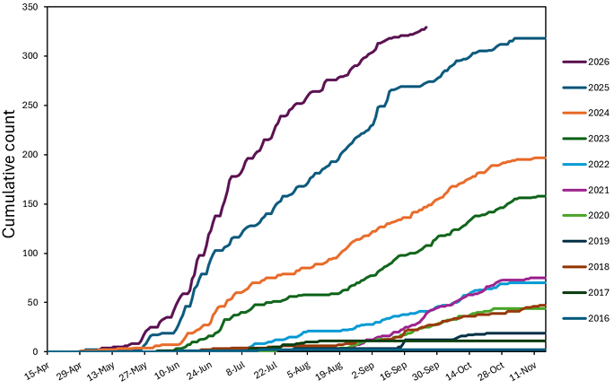
Dobos focused on Lower Granite Dam, showing that since the first walleye was observed there in 2016, abundance has only continued to increase. 350 fish have been trapped so far this year, which, based on PIT tag data, accounts for less than 5% of the total walleye entering the lower fish ladder. Dobos told the committee that while this trend is concerning, many walleye are not successful in getting past that lower section.
“The takeaway here is that the fish ladder does limit upstream movement of walleye to a certain extent. There are changes in operations that can be done to further limit movement of these fish. And we can use this potentially as a management tool to limit upstream migration at these hydrosystem facilities,” she said.
Dobos highlighted that many anglers enjoy catching walleye and might oppose reduction efforts. Part of IDFG’s outreach efforts include explaining why walleye are a problem, as well as asking anglers to help report walleye caught upstream of Lower Granite in hard-to-reach areas of the Lower Snake.
Fish and Wildlife Committee Chair Ed Schriever commented, “There’s a lot of fishing guides that are making good money taking people walleye fishing. That’s a sad state of affairs in my opinion. They should be making good money taking people salmon and steelhead fishing.”
Dobos also showed studies that connected the increase in walleye to a decrease in survival of juvenile steelhead, as well as other salmonids. “There’s a lot of indicators that this problem is persisting, it’s getting worse, and we need to think about what kind of actions need to be taken to decrease that predation risk,” she said.
Vogel began with other regional concerns, including the threats posed by invasive zebra and quagga mussels and avian predation, before turning to walleye and the Nez Perce Tribe’s new gillnetting efforts in Idaho, Washington, and Oregon. Vogel showed how the type of gillnet, as well as the time and location of deployment, are designed to avoid catching migrating salmon or steelhead.
While the work is very new, there are already some interesting results. At the Tucannon River, one gillnet that caught 56 walleye were scanned for PIT tags and showed that the walleye had consumed salmon from multiple hatcheries throughout the region, including the Rapid River, Redfish Lake, Grande Ronde, and Sawtooth Hatcheries. Vogel explained that each PIT tag could represent between 50 and several hundred smolts. He said they are considering future options to pay tribal anglers for netting walleye.
Finally, Dr. Matt Corsi with IDFG and Dr. Mike Quist with the Idaho Cooperative Fish and Wildlife Research Unit discussed their work on lake trout suppression efforts in Lake Pend Oreille and Yellowstone Lake. They warned that addressing walleye will be an even bigger and more complex challenge, requiring a rigorous scientific approach.
“I think it’s been a very positive thing to be able to be in a group where we can build relationships and trust…and have hard discussions,” said Dobos as the panel wrapped up. “And some of those discussions include challenging each other in some of these programs that have been ongoing for a long time and seeing where we can go with regards to change and what we need to do.”
Council members expressed support for efforts to address predation impacts on salmon and steelhead, including walleye in the Snake River. Committee Chair Schriever closed by saying, “We all need to continue to work together, or this is going to eat our lunch.”
Legal Disclaimer:
EIN Presswire provides this news content "as is" without warranty of any kind. We do not accept any responsibility or liability for the accuracy, content, images, videos, licenses, completeness, legality, or reliability of the information contained in this article. If you have any complaints or copyright issues related to this article, kindly contact the author above.
